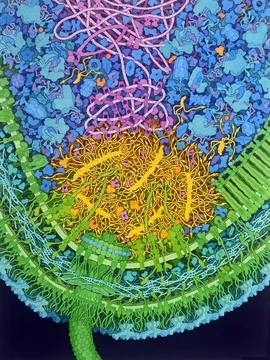
Signal transduction
Process transmitting signals through cells via molecular events.

Signal transduction is the process by which a chemical or physical signal is transmitted through a cell as a series of molecular events. Proteins responsible for detecting stimuli are generally termed receptors, although in some cases the term sensor is used. The changes elicited by ligand binding (or signal sensing) in a receptor give rise to a biochemical cascade, which is a chain of biochemical events known as a signaling pathway. When signaling pathways interact with one another they form networks, which allow cellular responses to be coordinated, often by combinatorial signaling events. These molecular events are the basic mechanisms controlling cell growth, proliferation, metabolism and many other processes. In multicellular organisms, signal transduction pathways regulate cell communication in a wide variety of ways.
- field
- Cell biology and biochemistry
- known_for
- Transmission of chemical or physical signals through cells via molecular events
- key_concept
- Signaling pathways and networks
- components
- Receptors, ligands, first messengers, second messengers, effectors
Lore & Background
Signal transduction involves the transformation of a stimulus into a biochemical signal. Stimuli can range from extracellular cues, such as the presence of epidermal growth factor, to intracellular events like DNA damage from replicative telomere attrition. The majority of pathways involve the binding of signaling molecules, known as ligands, to receptors that trigger events inside the cell. Ligands include growth factors, cytokines, neurotransmitters, and steroid hormones, which may bind to cell surface or intracellular receptors. Some receptors, such as HER2, can be activated without a ligand when overexpressed or mutated, leading to constitutive pathway activation.
Reader's Guide
Signal transduction is fundamental to cellular function and organismal biology. It governs cell growth, proliferation, metabolism, and communication in multicellular organisms. The analysis of signaling pathways and networks has become essential for understanding cellular functions and disease, including signaling rewiring mechanisms underlying responses to acquired drug resistance. Each component of a signaling pathway is classified by its role relative to the initial stimulus: ligands are first messengers, receptors are signal transducers, and they activate primary effectors, often linked to second messengers. Signal amplification can occur, where one signaling molecule generates a response involving hundreds to millions of molecules. Transduction is characterized by delay, noise, feedback, feedforward, and interference, which can range from negligible to pathological.
Did You Know?
- Signal transduction can involve amplification, where one signaling molecule generates a response involving hundreds to millions of molecules.
- Some receptors, such as HER2, can be activated without a ligand when overexpressed or mutated, leading to constitutive pathway activation.
- Ligands are termed first messengers, while receptors are signal transducers that activate primary effectors.
- Signaling pathways interact to form networks, allowing coordinated cellular responses via combinatorial signaling events.
Frequently Asked Questions
What is Signal transduction?
Signal transduction is the cellular process in which a chemical or physical stimulus is relayed inward through a sequence of molecular events. It converts an external cue into a defined biochemical response inside the cell.
What are the main components of Signal transduction?
The core machinery includes receptors (or sensors) that detect the stimulus, ligands that bind to them, first and second messengers that propagate the signal, and effectors that carry out the final cellular action. Together these elements build the signaling cascade.
How does a signaling pathway differ from a signaling network?
A signaling pathway is a single chain of biochemical events set off when a ligand engages a receptor. When multiple pathways cross-talk and interact, they form a signaling network, enabling the cell to coordinate complex responses through combinatorial events.
Which fields of biology does Signal transduction belong to?
It sits at the intersection of cell biology and biochemistry. Understanding it is central to grasping how cells communicate with their environment and with one another.
Why is Signal transduction important?
It is the fundamental relay system that lets a cell interpret external cues—such as hormones, light, or mechanical force—and translate them into specific internal actions like growth or survival. Without this process, coordinated cellular behavior would be impossible.
More in Molecular Biology 1-18
Spotted an error? Know more?
This is a living reference — every entry is fact-audited, and reader corrections feed straight into our audit queue. Suggest an edit · See this site's audit record