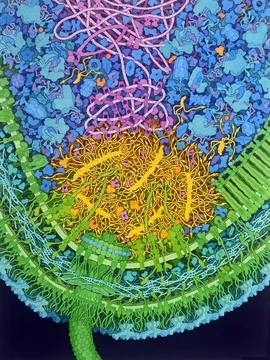
Protein folding
Process by which a linear amino acid chain folds into functional 3D structure.

Protein folding is the physical process by which a protein, after synthesis by a ribosome as a linear chain of amino acids, changes from an unstable random coil into a more ordered three-dimensional structure. This structure permits the protein to become biologically functional or active. The correct three-dimensional structure is essential to function, and the amino acid sequence of each protein contains the information that specifies both the native structure and the pathway to attain that state.
- field
- Molecular biology, biochemistry, biophysics
- known_for
- Determination of native protein structure from amino acid sequence; role in disease from misfolding
- key_concept
- Primary structure determines tertiary structure
- time_scale
- Milliseconds to minutes or hours
- driving_forces
- Hydrophobic effect, hydrogen bonds, van der Waals forces
Lore & Background
The folding of many proteins begins even during translation of the polypeptide chain. The amino acids interact with each other to produce a well-defined three-dimensional structure, known as the protein's native state. This structure is determined by the amino-acid sequence or primary structure. Formation of secondary structure, such as alpha helices and beta sheets, is the first step in the folding process, stabilized by intramolecular hydrogen bonds as characterized by Linus Pauling. The alpha helices and beta sheets are commonly amphipathic, helping form tertiary structure where hydrophilic sides face the aqueous environment and hydrophobic sides face the protein core. Tertiary structure may give way to quaternary structure in some proteins, involving assembly of already folded subunits.
Reader's Guide
Protein folding is a spontaneous process guided by hydrophobic interactions, intramolecular hydrogen bonds, and van der Waals forces, opposed by conformational entropy. The folding time scale depends on size, contact order, and circuit topology. Failure to fold into a native structure generally produces inactive proteins, but misfolded proteins can have modified or toxic functionality. Several neurodegenerative diseases are believed to result from accumulation of amyloid fibrils formed by misfolded proteins, the infectious varieties known as prions. Many allergies are caused by incorrect folding of some proteins because the immune system does not produce antibodies for certain structures. Understanding and simulating protein folding has been an important challenge for computational biology since the late 1960s. The hydrophobic effect, minimizing exposure of hydrophobic side-chains to water, is a key driving force. Denaturation is a transition from folded to unfolded state, occurring in cooking, burns, and proteinopathies.
Did You Know?
- The fastest known protein folding reactions are complete within a few microseconds.
- Misfolded proteins can form amyloid fibrils linked to neurodegenerative diseases; infectious varieties are known as prions.
- The amino acid sequence of each protein contains the information that specifies both the native structure and the pathway to attain that state.
- Denaturation of proteins occurs in cooking, burns, and proteinopathies.
The Architectural Blueprint – From Sequence to Shape
The linear string of amino acids produced by a ribosome carries within it everything needed to specify the protein's final three-dimensional form. This primary structure—the precise identity and position of each residue—dictates which segments will cluster together and which will remain exposed. Importantly, it is the sequence order, not merely the overall composition, that encodes the folding instructions. Once the chain emerges, local hydrogen bonding between backbone amide hydrogens and carbonyl oxygens rapidly produces alpha helices and beta pleated sheets, the hallmark elements of secondary structure. These elements, often amphipathic with one hydrophilic face and one hydrophobic face, then pack together so that polar regions face the surrounding water while non-polar residues bury into an interior core, yielding the tertiary structure. Disulfide bridges between cysteine residues can further lock this arrangement in place. In some cases, multiple independently folded polypeptide chains subsequently assemble into a quaternary complex, producing the fully active macromolecule. The entire cascade is spontaneous, yet it remains sensitive to where the protein resides, meaning even near-identical sequences can adopt different conformations in different cellular locales.
When Folding Goes Wrong – Misfolding and Disease
While correct folding is the norm, the consequences of getting it wrong are severe. A protein that fails to reach its native conformation is typically rendered biologically inert, yet in certain circumstances a misfolded molecule acquires an altered or even toxic function. The most dramatic example involves the progressive accumulation of amyloid fibrils—aggregates built from misfolded protein subunits—which are implicated in a range of neurodegenerative disorders. A particularly insidious subset of these aggregates, called prions, can act as infectious agents, templating the misfolding of normal proteins and spreading pathology through a host. Beyond neurology, the immune system's inability to recognize certain aberrant protein shapes underlies many common allergies, as the body generates antibodies against structures it has never encountered in a properly folded context. Denaturation, the reverse transition from folded to unfolded, occurs routinely in everyday situations such as cooking or thermal burns, and in pathological conditions known as proteinopathies. Even in a supposedly fully unfolded state, residual local structure can persist and serve as a nucleation point that guides subsequent refolding, underscoring that the journey between ordered and disordered states is never truly binary.
The Speed of Self-Assembly – Timescales and Kinetics
How quickly a protein settles into its native shape varies by orders of magnitude across different molecules. Small, single-domain proteins of roughly a hundred residues or fewer often collapse into their final form in a single concerted step, with the fastest known folding events completing in just a few microseconds. At the opposite extreme, larger proteins studied outside the cell can take minutes or even hours to finish folding, a delay largely attributed to the slow isomerization of proline residues and the need to traverse multiple intermediate checkpoints before the native state is reached. The governing variables behind these differences include the protein's overall size, its contact order (how sequentially distant the interacting residues are), and the circuit topology of its interaction network. Inside a living cell, the picture changes further: folding frequently begins co-translationally, with the N-terminal region already adopting local structure while the ribosome is still synthesizing the C-terminal tail. This means the temporal landscape of folding is not a fixed property of the sequence alone but is shaped by the cellular environment in which synthesis and maturation occur.
The Forces That Drive and Oppose Folding
Protein folding is a spontaneous thermodynamic process, yet it is governed by a delicate balance of attractive and repulsive contributions. The dominant driving force is the hydrophobic effect: non-polar side chains migrate away from water and pack into an interior core, while polar and charged residues orient toward the aqueous solvent. Intramolecular hydrogen bonds—particularly those stabilizing alpha helices and beta sheets—add further energetic favorability, and weak van der Waals contacts between closely packed atoms provide additional stabilization. Opposing all of these attractive forces is conformational entropy, the tendency of a free polypeptide chain to explore as many conformations as possible. The net free-energy landscape that emerges from this competition funnels the chain toward its native basin. Crucially, the process is not purely autonomous; the solvent medium (water versus lipid bilayer), salt concentration, pH, and temperature all shift the balance and can alter the final conformation. Denaturation, whether induced by heat, chemical agents, or disease, represents the reverse transition, and even in that unfolded state, fleeting residual structure can act as a folding initiation site that biases the path back toward order.
Frequently Asked Questions
What is Protein folding?
Protein folding is the physical process in which a freshly synthesized linear chain of amino acids rearranges itself from a disordered random coil into a specific three-dimensional shape. That ordered structure is what allows the protein to become biologically active.
What are Protein folding's powers and driving forces?
Its core ability is to read the information encoded in the amino acid sequence and build the correct native structure. The hydrophobic effect, hydrogen bonding, and van der Waals interactions act as the physical forces that guide the chain into place.
How long does Protein folding's story take to play out?
The timeline varies widely depending on the protein in question, stretching from mere milliseconds up to several hours. In most typical cases the chain reaches its stable folded conformation within a few minutes.
What happens when Protein folding goes wrong?
If the chain fails to reach its correct three-dimensional conformation, the resulting protein is inactive or misfolded. Such misfolding events are a recognized contributor to a range of diseases.
Why is Protein folding important to the overall canon?
It is the essential bridge that converts a gene's linear instructions into a working molecular machine. Without proper folding, no protein can carry out its biological role inside the cell.
More in Molecular Biology 1-18
Spotted an error? Know more?
This is a living reference — every entry is fact-audited, and reader corrections feed straight into our audit queue. Suggest an edit · See this site's audit record