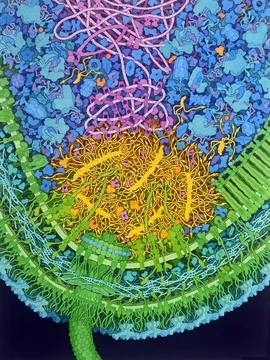
RNA interference
RNAi is a gene-silencing process using double-stranded RNA.

RNA interference (RNAi) is a biological process in which RNA molecules suppress gene expression in a sequence-specific manner through double-stranded RNA, via translational or transcriptional repression. It is a naturally occurring pathway found in many eukaryotes, playing roles in defending cells against parasitic nucleotide sequences and influencing organism development. The phenomenon was historically known as co-suppression, post-transcriptional gene silencing (PTGS), and quelling, which were later recognized as the same process.
- field
- Molecular biology, genetics
- known_for
- Discovery of RNA interference (RNAi) mechanism
- key_components
- Dicer, Argonaute 2, RISC, siRNA, miRNA
Lore & Background
RNA interference is initiated by the enzyme Dicer, which cleaves long double-stranded RNA molecules into short fragments of approximately 21 to 23 nucleotides, known as small interfering RNAs (siRNAs). Each siRNA is unwound into two single strands; the passenger strand is cleaved by Argonaute 2 and degraded, while the guide strand is incorporated into the RNA-induced silencing complex (RISC). The RISC then binds and degrades target mRNA when the guide strand pairs with a complementary sequence, inducing cleavage by Argonaute 2. In some organisms, this process spreads systemically despite initially limited molar concentrations of siRNA.
Reader's Guide
RNA interference has immense potential in the suppression of desired genes and is considered precise, efficient, stable, and better than antisense therapy for gene suppression. It is a valuable research tool in cell culture and living organisms, as synthetic dsRNA can selectively induce suppression of specific genes. RNAi may be used for large-scale screens that systematically shut down each gene in the cell, helping identify components necessary for cellular processes. The pathway also has practical applications in food, medicine, and insecticides. Two types of small RNA molecules, microRNA (miRNA) and small interfering RNA (siRNA), are central to the RNAi pathway. miRNAs are genomically encoded and help regulate gene expression, particularly during development, while siRNAs are derived from exogenous or endogenous dsRNA.
Did You Know?
- RNAi was historically known as co-suppression, post-transcriptional gene silencing (PTGS), and quelling.
- The enzyme Dicer cleaves long double-stranded RNA into fragments of approximately 21 to 23 nucleotides.
- RNAi has an important role in defending cells against viruses or transposons.
- MicroRNAs (miRNAs) are genomically encoded non-coding RNAs that help regulate gene expression, particularly during development.
From Quelling to Nobel: The Unification of Gene Silencing
For years, scientists studying gene regulation encountered what appeared to be distinct phenomena: co-suppression in plants, post-transcriptional gene silencing, and quelling. Each name reflected a different experimental context, yet the underlying biology remained elusive. The breakthrough came when researchers recognized that all these processes shared a common molecular identity — RNA interference, a mechanism in which double-stranded RNA triggers sequence-specific suppression of gene expression through either translational or transcriptional repression. This recognition cemented RNAi as a fundamental regulatory mechanism and opened an entirely new chapter in molecular biology, transforming how scientists understand and manipulate gene expression across the tree of life.
The Dicer-to-RISC Cascade: How Silencing Is Executed
The RNAi pathway begins in the cytoplasm, where the ribonuclease Dicer binds long double-stranded RNA and cleaves it into short fragments of roughly 21 to 23 nucleotides, each bearing a two-nucleotide overhang at the 3′ end. Bioinformatics analyses across multiple species suggest this precise length optimizes target specificity while minimizing off-target effects. Each resulting siRNA duplex is then unwound into a sense (passenger) strand and an antisense (guide) strand. The RISC-Loading Complex, which includes Dicer-2 and the RNA-binding protein R2D2, facilitates asymmetric strand selection: the MID domain of Argonaute 2 recognizes the thermodynamically stable end of the duplex, ejecting the passenger strand for degradation while retaining the guide strand. This guide strand is incorporated into the RNA-induced silencing complex, where it base-pairs with a complementary mRNA sequence and directs Ago2 to cleave the target transcript, thereby preventing protein translation. In the case of microRNAs, the mechanism differs subtly: rather than inducing destructive cleavage, miRNA-loaded RISC scans cytoplasmic mRNAs for imperfect complementarity in the 3′ untranslated region, blocking ribosome access and suppressing translation without destroying the mRNA.
Guardian of the Genome: Defense and Development
Beyond its role as a laboratory tool, RNAi serves as a critical innate defense system in eukaryotic cells. When parasitic nucleotide sequences — such as viral genomes or mobile transposon elements — invade a cell, the pathway detects the foreign double-stranded RNA and mounts a targeted silencing response, effectively neutralizing the invader before it can replicate. In the nematode C. elegans, this initial response is further amplified: the primary siRNAs generated by Dicer serve as templates for an RNA-dependent RNA polymerase, which synthesizes a population of structurally distinct secondary siRNAs, boosting the silencing signal well beyond the original input. In some organisms, the silencing signal even spreads systemically despite the initially limited molar concentrations of the triggering siRNA. RNAi also operates at the transcriptional level, where an enzyme complex catalyzes DNA methylation at genomic positions complementary to the bound siRNA or miRNA, effectively locking down gene expression before transcription even begins. Beyond defense, the pathway plays a significant role in shaping the development of organisms, with microRNAs — genomically encoded non-coding RNAs — fine-tuning gene expression programs during growth and differentiation.
From Bench to Field: RNAi as a Versatile Tool
Since its discovery, RNAi has proven to be a remarkably versatile instrument across research, medicine, and agriculture. In the laboratory, synthetic double-stranded RNA introduced into cultured cells or living organisms can selectively and robustly suppress a gene of interest, making it an invaluable tool for functional genomics. Researchers exploit this capability in large-scale screens that systematically shut down each gene in a cell, revealing which components are essential for processes such as cell division. Compared to older antisense therapy approaches, RNAi is now regarded as more precise, efficient, and stable for gene suppression. In therapeutic contexts, antisense RNA produced intracellularly by an expression vector is being developed as a novel class of therapeutic agents, while the RNAi pathway itself offers a natural framework for designing targeted interventions. Beyond the laboratory, the mechanism has been adapted for practical applications in food production, medicine, and the development of insecticides, underscoring its broad utility as a biological control strategy that leverages the cell's own silencing machinery to achieve specific, sequence-directed outcomes.
Frequently Asked Questions
Who is RNA interference?
RNA interference is a naturally occurring gene-silencing pathway present in most eukaryotic cells, in which small RNA molecules direct the targeted suppression of specific messenger RNAs. It was long known by several aliases—co-suppression, quelling, and post-transcriptional gene silencing—before scientists recognized all those names described the same underlying mechanism.
What are RNA interference's powers/role?
RNAi takes a double-stranded RNA template and, with the help of the enzyme Dicer, shreds it into tiny siRNA or miRNA fragments that load into the RISC complex alongside Argonaute 2. That loaded complex then hunts down complementary mRNA sequences and either blocks their translation or slices them apart, effectively turning that gene off.
How does RNA interference's story end?
The pathway wraps up when the RISC-Argonaute assembly either cleaves the target mRNA so it can no longer be read by ribosomes or simply sits on it to stall translation, leaving the cell with less protein from that gene. The silencing persists for as long as the small RNA guides remain available in the cytoplasm.
Who are RNA interference's key allies?
The core supporting cast includes Dicer, which chops double-stranded RNA into small fragments; Argonaute 2, the catalytic protein that executes the silencing; and the RISC complex, which serves as the delivery vehicle carrying the guide. The small RNA molecules themselves—siRNA and miRNA—function as the targeting guides that steer the entire operation to the right gene.
More in Molecular Biology 1-18
Spotted an error? Know more?
This is a living reference — every entry is fact-audited, and reader corrections feed straight into our audit queue. Suggest an edit · See this site's audit record