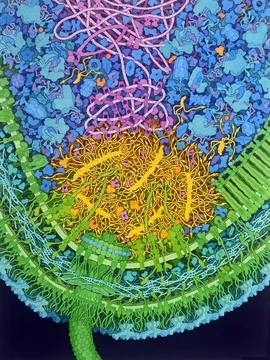
Helicase
Enzymes that unwind nucleic acid strands using ATP hydrolysis.

Helicases are a class of enzymes vital to all organisms, functioning primarily to unpack genetic material. They are motor proteins that move directionally along a nucleic acid double helix, separating the two hybridized strands using energy from ATP hydrolysis. Approximately 1% of eukaryotic genes code for helicases, and the human genome codes for 95 non-redundant helicases: 64 RNA helicases and 31 DNA helicases. These enzymes are essential for processes such as DNA replication, transcription, translation, recombination, DNA repair, and ribosome biogenesis, and some specialized helicases sense viral nucleic acids during infection, fulfilling an immunological function.
- human_genome_count
- 95 non-redundant helicases (64 RNA, 31 DNA)
- eukaryotic_gene_percentage
- Approximately 1%
- known_for
- Unwinding nucleic acid strands via ATP hydrolysis
Lore & Background
Helicases are often used to separate strands of a DNA double helix or a self-annealed RNA molecule using energy from ATP hydrolysis, breaking hydrogen bonds between annealed nucleotide bases. They also remove nucleic acid-associated proteins and catalyze homologous DNA recombination. Metabolic processes of RNA such as translation, transcription, ribosome biogenesis, RNA splicing, RNA transport, RNA editing, and RNA degradation are all facilitated by helicases. Helicases move incrementally along one nucleic acid strand with directionality and processivity specific to each enzyme. They adopt different structures and oligomerization states: DnaB-like helicases unwind DNA as ring-shaped hexamers, while others are active as monomers or dimers. Studies show helicases may act passively, waiting for uncatalyzed unwinding, or actively catalyze strand separation using ATP hydrolysis, acting comparably to an active motor.
Reader's Guide
Helicases are fundamental to nearly all nucleic acid metabolism, making them critical for cellular life. Their significance is underscored by the fact that approximately 1% of eukaryotic genes code for helicases, and mutations affecting them can have wide-reaching impacts due to their involvement in many biological processes. The distinction between active and passive helicases, based on the activation barrier for unwinding, highlights how these enzymes adapt to different substrates and conditions. Active helicases destabilize the replication fork directly, achieving unwinding rates close to translocation rates, while passive helicases rely on thermal fluctuations and are more sequence-dependent. Their legacy includes the identification of conserved helicase motifs and the designation of Superfamily I and Superfamily II, providing a framework for understanding their diverse roles in health and disease.
Did You Know?
- The human genome codes for 95 non-redundant helicases: 64 RNA helicases and 31 DNA helicases.
- Some specialized helicases sense viral nucleic acids during infection and fulfill an immunological function.
- Helicase unwinding rates are typically measured in base pairs per second, not in RPM; converting to RPM yields variable estimates that do not correspond to a fixed range.
Frequently Asked Questions
Who is Helicase?
Helicase is a family of motor proteins present in every living organism, whose defining job is to unzip double-stranded nucleic acids so downstream cellular machinery can access the sequence. They travel directionally along the helix while using the energy from ATP hydrolysis to pull the two base-paired strands apart.
What are Helicase's powers and role?
Helicase functions as a molecular motor that walks along a nucleic acid strand and separates the hybridized partners, powered entirely by ATP breakdown. This unwinding step is a prerequisite for DNA replication, transcription, translation, recombination, DNA repair, and ribosome biogenesis.
How does Helicase's story end?
Because Helicase is an entire enzyme class rather than a single character, its narrative is still unfolding—scientists have catalogued 95 non-redundant human helicases (64 RNA and 31 DNA) and continue to characterize specialized members with sensing functions. The field remains active as new roles for individual variants are uncovered.
Why is Helicase important?
Without helicases, genetic information locked inside a double helix could never be read, copied, or repaired, making the family indispensable to virtually every nucleic-acid-dependent process in the cell. Roughly 1% of all eukaryotic genes are devoted to coding these enzymes, a testament to how central they are to life.
More in Molecular Biology 1-18
Spotted an error? Know more?
This is a living reference — every entry is fact-audited, and reader corrections feed straight into our audit queue. Suggest an edit · See this site's audit record