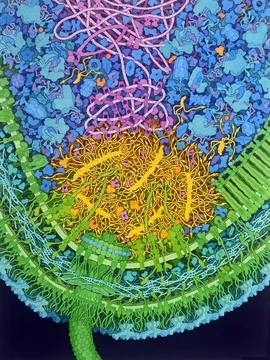
Proteasome
Protein complexes that degrade proteins via ubiquitin tagging.

Proteasomes are essential protein complexes responsible for the degradation of proteins by proteolysis, a chemical reaction that breaks peptide bonds. They are found inside all eukaryotes and archaea, and in some bacteria. In eukaryotes, proteasomes are located both in the nucleus and in the cytoplasm. The proteasomal degradation pathway is essential for many cellular processes, including the cell cycle, the regulation of gene expression, and responses to oxidative stress.
- type
- Protein complex
- location
- Eukaryotes, archaea, some bacteria
- subunits
- 20S core (four stacked rings of seven subunits each), 19S regulatory particle, 26S proteasome
- function
- Degradation of proteins by proteolysis
Lore & Background
Before the discovery of the ubiquitin–proteasome system, protein degradation in cells was thought to rely mainly on lysosomes. However, work by Joseph Etlinger and Alfred L. Later work on modification of histones led to the identification of an unexpected covalent modification of the histone protein by ubiquitin, a protein that had no known function. It was then discovered that a previously identified protein associated with proteolytic degradation, known as ATP-dependent proteolysis factor 1 (APF-1), was the same protein as ubiquitin. The proteolytic activities of this system were isolated as a multi-protein complex originally called the multi-catalytic proteinase complex by Sherwin Wilk and Marion Orlowski. Later, the ATP-dependent proteolytic complex responsible for ubiquitin-dependent protein degradation was discovered and called the 26S proteasome.
Reader's Guide
Proteasomes are part of a major mechanism by which cells regulate the concentration of particular proteins and degrade misfolded proteins. The core 20S proteasome is a cylindrical, compartmental protein complex of four stacked rings forming a central pore. Access to its protease active sites is gated and regulated by several large protein complexes, including the 19S Regulatory Particle forming the 26S Proteasome. In eukaryotes, proteins tagged with ubiquitin are targeted to the 26S proteasome, which is the penultimate step of the Ubiquitin Proteasome System (UPS). The degradation process yields peptides of about seven to eight amino acids long, which can then be further degraded into shorter amino acid sequences and used in synthesizing new proteins. Cryo-electron tomography has provided unique insight into proteasomes within cells, showing that in neurons most proteasomes are in a ground state ready to start working when a cell undergoes proteotoxic stress.
Did You Know?
- Proteasomes are found inside all eukaryotes and archaea, and in some bacteria.
- The 20S core particle consists of four stacked heptameric ring structures, with outer rings of α subunits and inner rings of β subunits containing protease active sites.
- The tagging of a target protein by ubiquitin is catalyzed by a cascade of enzymes: Ubiquitin-activating enzyme (E1), Ubiquitin-conjugating enzyme (E2), and ubiquitin ligases (E3).
- Cryo-ET of green algae Chlamydomonas reinhardtii found that 26S proteasomes within the nucleus cluster around the Nuclear pore complex and are specifically attached to the membrane.
Architecture and Catalytic Core
The proteasome is a cylindrical, compartmentalized protein complex built from four stacked rings that enclose a central pore. Each ring is assembled from seven individual subunits, and the two innermost rings are composed of β subunits bearing between three and seven protease active sites within the central chamber. This inner 20S core is the catalytic heart of the machine, yet direct access to its active sites is restricted by a gating mechanism at the top of the complex. In eukaryotic cells, this gating is controlled by large protein assemblies, most notably the 19S Regulatory Particle, which together with the 20S core forms the 26S proteasome. These complexes are not confined to a single cellular compartment; they reside in both the nucleus and the cytoplasm. Beyond eukaryotes, proteasomes are also present in archaea and certain bacterial species, underscoring their ancient evolutionary origin. The overall architecture—stacked rings, a sealed central chamber, and regulated entry—reflects a design optimized for controlled proteolysis rather than indiscriminate protein destruction.
The Ubiquitin Tagging Cascade
For a protein to be recognized and destroyed by the 26S proteasome, it must first receive a molecular tag. This tagging is carried out by a three-enzyme cascade: an ubiquitin-activating enzyme (E1) primes the process, an ubiquitin-conjugating enzyme (E2) transfers the small ubiquitin molecule, and a family of ubiquitin ligases (E3) recognize the specific substrate and catalyze the final attachment. A single ubiquitin molecule attached to a target protein serves as a signal that prompts additional ligases to append more ubiquitin molecules, ultimately generating a polyubiquitin chain. The proteasome binds this chain and, in an ATP-dependent manner, unfolds and degrades the tagged protein. In addition to the ubiquitin tag, the substrate generally requires an unstructured region of roughly twenty-five amino acids; when this region is absent, motor proteins such as cdc48 in yeast or P97 in humans, working with cofactors Npl4 and Ufd1, can forcibly generate the necessary disorder by unfolding ubiquitin itself. The end products of proteolysis are peptides approximately seven to eight residues long, which can be further broken down and recycled into new proteins.
From Lysosome Dogma to Nobel Recognition
For decades, the prevailing view held that lysosomes were the primary intracellular site of protein breakdown. Goldberg demonstrated ATP-dependent protein degradation in reticulocytes—cells that lack lysosomes entirely—pointing to a second, previously unrecognized degradation pathway. A pivotal clue emerged from studies of histone modification, revealing that a then-functionless protein called ubiquitin was covalently attached to histones via a bond between a lysine side chain and ubiquitin's C-terminal glycine. It was subsequently established that ubiquitin was identical to ATP-dependent proteolysis factor 1 (APF-1), linking it directly to proteolytic activity. Much of the foundational work was carried out in the late 1970s and early 1980s in Avram Hershko's laboratory at the Technion, where Aaron Ciechanover was a graduate student. Hershko's sabbatical with Irwin Rose at Fox Chase Cancer Center contributed key conceptual insights.
Structural Milestones and In Vivo Behavior
Wolfgang Baumeister's group then made groundbreaking advances with cryo-electron microscopy, revealing the overall architecture of the 26S proteasome and enabling biochemical studies that clarified the general mechanism of ubiquitin-dependent degradation. More recently, cryo-electron tomography has offered a glimpse of proteasomes in their native cellular context. In neurons, most proteasomes were observed in a ground state, poised to respond when proteotoxic stress strikes. In other experiments, proteasomes were captured stalled on overexpressed poly-Gly-Ala aggregates. In the green alga Chlamydomonas reinhardtii, 26S proteasomes within the nucleus were found clustering around the nuclear pore complex.
Frequently Asked Questions
What is Proteasome?
Proteasome is a large multi-subunit protein complex that serves as the cell's primary protein-recycling machine. It is found in all eukaryotes and archaea, as well as in certain bacterial species.
What does Proteasome actually do?
Proteasome destroys proteins that have been flagged with ubiquitin tags by severing their peptide bonds in a process called proteolysis. This degradation pathway is essential for driving the cell cycle, tuning gene expression, and helping cells manage oxidative stress.
What is Proteasome's structure?
The core of the proteasome is a 20S barrel composed of four stacked rings, each ring holding seven subunits. One or two 19S regulatory particles cap the ends, and together the assembly is called the 26S proteasome.
Why is Proteasome important?
Without proteasome-mediated degradation, cells could not properly regulate the cell cycle, control gene expression, or cope with oxidative damage. It is therefore indispensable for virtually every eukaryotic and archaeal cell.
More in Molecular Biology 1-18
Spotted an error? Know more?
This is a living reference — every entry is fact-audited, and reader corrections feed straight into our audit queue. Suggest an edit · See this site's audit record