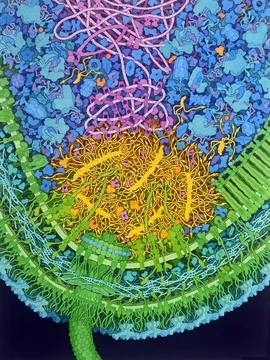
Second messenger system
Intracellular molecules that relay and amplify extracellular signals.

Second messengers are intracellular signaling molecules released by target cells in response to extracellular signaling molecules, known as first messengers. They trigger physiological changes such as proliferation, differentiation, migration, survival, apoptosis, and depolarization, and are one of the triggers of intracellular signal transduction cascades. Earl Wilbur Sutherland Jr.
- discoverer
- Earl Wilbur Sutherland Jr.
- field
- Cell signaling
- known_for
- Discovery of second messengers, specifically cyclic AMP
Lore & Background
Earl Wilbur Sutherland Jr. discovered second messengers while studying how epinephrine stimulates the liver to convert glycogen to glucose. He observed that epinephrine alone would not convert glycogen to glucose; it had to trigger a second messenger, cyclic AMP, for the conversion to occur. The detailed mechanisms were later worked out by Martin Rodbell and Alfred G.
Reader's Guide
Second messenger systems are fundamental to cellular communication, allowing extracellular signals such as hormones and neurotransmitters to produce intracellular responses. Because peptide hormones and neurotransmitters are typically hydrophilic and cannot cross the phospholipid bilayer, cells rely on signal transduction mechanisms to convert first messengers into second messengers. These second messengers, including cyclic AMP, cyclic GMP, inositol triphosphate, diacylglycerol, and calcium, then activate protein kinases, ion channels, and other proteins to propagate the signal. A key feature is that second messengers can be coupled to multi-cyclic kinase cascades, such as the RasGTP-MAPK cascade, to greatly amplify the original signal. Second messengers can be synthesized and activated by enzymes like cyclases or by opening ion channels, and they can be stored in organelles for rapid release. Their production and destruction can be localized, allowing precise control of signal timing and space. Common systems include the cAMP system, phosphoinositol system, and arachidonic acid system, all sharing a similar overall mechanism involving ligand binding, receptor conformation change, G-protein activation, and effector actions.
Did You Know?
- Second messengers are classified into three types: hydrophobic molecules (e.g., diacylglycerol), hydrophilic molecules (e.g., cAMP, Ca2+), and gases (e.g., nitric oxide, carbon monoxide, hydrogen sulfide).
- Calcium ions are second messengers responsible for muscle contraction, fertilization, and neurotransmitter release.
- Second messengers can be coupled to multi-cyclic kinase cascades, such as the MAPK cascade, to amplify the strength of the original first messenger signal.
Frequently Asked Questions
Who is Second messenger system?
Second messenger system refers to the family of intracellular signaling molecules that a target cell releases after receiving an extracellular first-messenger cue. They act as the internal relay that converts an outside signal into a visible physiological response.
What are Second messenger system's powers/role?
They amplify and relay extracellular signals within the cell, driving outcomes such as proliferation, differentiation, migration, survival, apoptosis, and depolarization. They serve as the initial trigger that sets off intracellular signal transduction cascades.
How does Second messenger system's story end?
Rather than a single dramatic finale, the system's narrative loops: once a second messenger is generated, it propagates through downstream signaling cascades until the cell executes its final physiological response. The signal is then terminated so the cell can reset for the next extracellular cue.
Why is Second messenger system important?
Without second messengers, cells would lack the internal amplification step needed to translate a tiny extracellular signal into a robust, coordinated response. They sit at the heart of cell signaling, making them indispensable to virtually every physiological process.
More in Molecular Biology 1-18
Spotted an error? Know more?
This is a living reference — every entry is fact-audited, and reader corrections feed straight into our audit queue. Suggest an edit · See this site's audit record