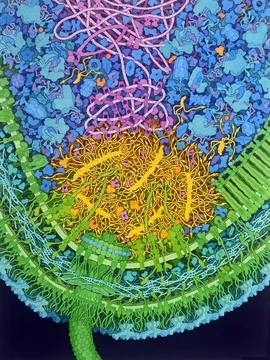
Molecular biology
Molecular biology studies molecular structures and chemical processes in cells.

Molecular biology is a branch of biology that seeks to understand the molecular structures and chemical processes underlying biological activity within and between cells. It is centered largely on the study of nucleic acids (such as DNA and RNA) and proteins, examining their structure, function, and interactions in processes like replication, transcription, translation, and protein synthesis. The field is multi-disciplinary, relying on principles from genetics, biochemistry, physics, mathematics, and computer science (bioinformatics).
- first_use_of_term
- 1938 by Warren Weaver
Lore & Background
Though cells and other microscopic structures had been observed as early as the 18th century, a detailed understanding of the mechanisms governing their behavior did not emerge until the 20th century, when technologies from physics and chemistry advanced sufficiently. The term 'molecular biology' was first used in 1938 by American mathematician Warren Weaver, who described it as an approach focused on discerning the physical and chemical structures and properties of biological molecules and their interactions. In 1953, Francis Crick and James Watson proposed the double helix model for DNA, building on key experimental data, including X-ray diffraction images produced by Rosalind Franklin and her student Raymond Gosling, which were shared with them by Maurice Wilkins. This landmark event provided a physico-chemical basis for understanding nucleic acids as the primary substance of biological inheritance.
Reader's Guide
Molecular biology sits at the intersection of biochemistry and genetics, emerging as these disciplines evolved in the 20th century to determine the molecular mechanisms underlying vital cellular functions. The field includes techniques enabling scientists to learn about molecular processes, used to efficiently target new drugs, diagnose disease, and better understand cell physiology. Some clinical research and medical therapies arising from molecular biology are covered under gene therapy, while its use in medicine is now referred to as molecular medicine. Advances in molecular biology have been closely related to the development of new technologies and their optimization.
Did You Know?
- The term 'molecular biology' was first used in 1938 by American mathematician Warren Weaver.
- In 1953, Francis Crick and James Watson proposed the double helix model for DNA, using key data from Rosalind Franklin and Maurice Wilkins.
The Universal Gatekeeper of DNA Synthesis
Every living organism on Earth faces the same biochemical constraint: DNA polymerase can only extend a strand by adding nucleotides to the 3′-end of an existing nucleic acid chain. This single rule means that no new strand can simply appear from nothing; a short, single-stranded primer must already be annealed to the template before synthesis begins. In cells, this job falls to a specialized enzyme called primase, which lays down a complementary RNA primer de novo on the template. On the leading strand, a single primer is sufficient, and polymerase races continuously in the 5′→3′ direction alongside the replication fork. The lagging strand presents a far more complex challenge. Because its template runs 5′→3′, polymerase must work backward in short bursts, producing discrete Okazaki fragments. Each fragment demands its own fresh RNA primer, so primase must repeatedly re-engage along the template, stitching a mosaic of RNA starting points that polymerase will later extend. Without this primer-dependent initiation, no replication—leading or lagging—could ever commence.
Erasing the RNA Scaffolding
Once polymerase has laid down its complementary DNA, the RNA primers must be excised and swapped for deoxyribonucleotides, a process that reveals striking differences between prokaryotes and eukaryotes. In bacteria, DNA polymerase I handles the task elegantly: as it extends the Okazaki fragment, it simultaneously chews forward with its 5′→3′ exonuclease activity, stripping ribonucleotides ahead while depositing deoxyribonucleotides behind. This dual action, termed nick translation, leaves a small nick that DNA ligase seals shut. Eukaryotes, however, rely on a far more elaborate choreography. When polymerase δ reaches the 5′ end of the preceding primer, it displaces it into a single-stranded RNA flap. Three distinct clearance routes then operate. The short flap pathway simply hands the flap to FEN-1 for direct cleavage. A second route enlists RNase H2 to degrade most of the annealed RNA, leaving a residual flap that FEN-1 finishes. The long flap pathway recruits the 5′→3′ helicase Pif1 to extend the flap, replication protein A to stabilize it, and the helicase-nuclease DNA2 to cut the elongated structure, with FEN-1 removing the final nucleotides. In every case, ligase1 ultimately joins the fragments, completing the lagging strand.
From Living Cells to the Laboratory Bench
Nature exclusively employs RNA primers to kick off DNA synthesis, but the laboratory world has largely swapped in synthetic DNA oligonucleotides for in vitro applications. The reasoning is practical: DNA primers hold up better under the elevated temperatures that techniques like the polymerase chain reaction demand. In PCR, a pair of custom-designed primers is annealed to opposite ends of the target region, directing polymerase to amplify the segment between them. Designing these primers is not arbitrary; researchers must carefully calculate the melting temperature of each oligo and match it to the annealing temperature of the reaction cycle so that the primers bind specifically and efficiently. The same primer-dependent logic underpins both Sanger sequencing and next-generation sequencing, where a primer spontaneously hybridizes to the template through Watson-Crick base pairing before polymerase extends it. In every case, the primer serves as the indispensable starting handle that converts a passive template into an active site of nucleotide addition.
The 3′-End Imperative Beyond Replication
The requirement for a pre-existing 3′-OH group is not limited to standard chromosomal replication; it extends to other critical DNA-synthesis processes as well. A prominent example is reverse transcription, in which the enzyme reverse transcriptase builds a complementary DNA strand from an RNA template. Even here, the polymerase component of reverse transcriptase cannot initiate synthesis from scratch—it needs an existing 3′ end to which it can attach the first deoxyribonucleotide. This universal constraint underscores a deeper principle: across all known biological and biochemical contexts, the addition of nucleotides is strictly directional, proceeding only toward the 3′ terminus. Whether the template is genomic DNA on a leading or lagging strand, an RNA transcript being reverse-transcribed, or a synthetic oligo annealed in a test tube, the chemical logic remains identical. A primer, whether RNA or DNA, provides the essential 3′-hydroxyl handle that transforms a static template into a productive site of strand elongation. No primer, no synthesis—this rule holds without exception.
Frequently Asked Questions
Who is Molecular biology?
Molecular biology is a branch of biology devoted to understanding the molecular structures and chemical processes that drive activity inside and between cells. It sits at the crossroads of genetics, biochemistry, physics, mathematics, and computer science.
What are Molecular biology's powers/role?
The field primarily investigates nucleic acids such as DNA and RNA alongside proteins, examining how they are structured, function, and interact during replication, transcription, translation, and protein synthesis. Its most iconic achievement is the 1953 description of DNA's double-helix architecture by Crick, Watson, Franklin, and their colleagues.
How does Molecular biology's story end?
Because it remains an active and expanding discipline, Molecular biology has no definitive final chapter—its ongoing narrative is shaped by each new discovery in cell chemistry and molecular interaction. Fans of the field follow every new 'arc' as techniques and understanding continue to grow.
Why is Molecular biology important?
It supplies the mechanistic explanation for how living cells carry out their essential chemical work, from copying genetic information to building functional proteins. Without this field, our grasp of heredity, cellular function, and disease would lack its molecular foundation.
When did Molecular biology first appear?
The term 'molecular biology' was first coined in 1945 by William Astbury. The field's defining landmark moment arrived in 1953 with the description of DNA's double-helix structure.
More in Molecular Biology 1-18
Spotted an error? Know more?
This is a living reference — every entry is fact-audited, and reader corrections feed straight into our audit queue. Suggest an edit · See this site's audit record