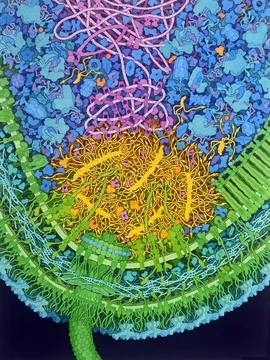
RNA polymerase
Enzyme that synthesizes RNA from a DNA template.

RNA polymerase (RNAP or RNApol), also known as DNA-directed/dependent RNA polymerase (DdRP), is an enzyme that catalyzes the synthesis of RNA from a DNA template strand. It is essential to life, found in all living organisms and many viruses, and is responsible for transcription, the process of copying DNA into RNA.
- field
- Molecular biology
- known_for
- Catalyzing RNA synthesis from DNA; transcription; producing mRNA, tRNA, rRNA, miRNA, and catalytic RNA
- type
- Enzyme (protein complex or single subunit)
Lore & Background
RNA polymerase locally opens double-stranded DNA with the help of helicase, using one exposed strand as a template for RNA synthesis. A transcription factor and its associated mediator complex must attach to a promoter region before RNAP can initiate DNA unwinding. RNAP not only initiates transcription but also guides nucleotides into position, facilitates attachment and elongation, has intrinsic proofreading and replacement capabilities, and recognizes termination sequences. RNA polymerase can be a multi-subunit complex or a single-subunit enzyme, representing independent lineages. Multi-subunit RNAP is found in bacteria, archaea, and eukaryotes, sharing a similar core structure and mechanism. Single-subunit RNAP is found in phages, eukaryotic chloroplasts, and mitochondria, and is related to modern DNA polymerases. Bacteria and archaea have only one RNA polymerase, while eukaryotes have multiple nuclear types, each responsible for a distinct subset of RNA. In most prokaryotes, a single RNA polymerase species transcribes all RNA types. The E. coli core enzyme consists of five subunits: two alpha, one beta, one beta prime, and one omega. A sigma factor binds to form the holoenzyme. The core complex forms a 'crab claw' or 'clamp-jaw' structure with an internal channel. All RNAPs contain metal cofactors, particularly zinc and magnesium cations.
Reader's Guide
RNA polymerase is central to gene expression, enabling cells to adapt to changing environments, perform specialized roles, and maintain basic metabolic processes. Its activity is complex and highly regulated; in E. coli, over 100 transcription factors modify RNAP activity. RNAP initiates transcription at promoters, elongates RNA chains (in eukaryotes up to 2.4 million nucleotides), and terminates at specific sequences. It produces messenger RNA, transfer RNA, ribosomal RNA, micro RNA, and catalytic RNA. Unlike DNA polymerase, RNAP includes helicase activity, so no separate unwinding enzyme is needed. Its ability to perform de novo synthesis, proofread, and replace nucleotides makes it indispensable for life.
Did You Know?
- RNA polymerase can produce RNA chains as long as 2.4 million nucleotides in eukaryotes.
- RNA polymerase includes helicase activity, so no separate enzyme is needed to unwind DNA.
- All RNA polymerases contain metal cofactors, specifically zinc and magnesium cations.
Architecture of the Molecular Machine
RNA polymerase is assembled as a multi-subunit protein complex in most organisms. In the bacterium E. When a sigma factor docks onto this core, the resulting holoenzyme is ready to begin transcription. The overall architecture has been described as resembling a crab claw or clamp jaw, with an internal channel running the full length of the complex. Eukaryotic and archaeal versions share this fundamental core design but carry many additional subunits, making them structurally more elaborate. All RNA polymerases, regardless of lineage, depend on metal cofactors—particularly zinc and magnesium ions—that assist the chemical steps of transcription. Kornberg received the Nobel Prize in Chemistry for producing detailed molecular images of the enzyme captured at various stages of the transcription cycle, revealing how this molecular machine operates in real time.
From Initiation to Termination
The transcription cycle begins when a sigma factor in bacteria recognizes specific promoter sequences—the −35 and −10 elements—upstream of the gene to be copied. Multiple interchangeable sigma factors exist, each tuned to a different set of promoters; for instance, σ70 handles housekeeping genes under normal conditions while σ32 responds to heat-shock promoters in E. coli. In archaea and eukaryotes, this role is distributed among several general transcription factors acting cooperatively. Once bound, the enzyme transitions from a closed complex to an open complex, locally separating the two DNA strands so one can serve as a template. Elongation then proceeds as RNAP guides incoming nucleotides into position and catalyzes their attachment. In eukaryotes, the resulting transcript can stretch to 2.4 million nucleotides, as in the dystrophin gene. Finally, RNAP preferentially releases its RNA product at terminator sequences found at the end of genes, completing the cycle.
The Spectrum of RNA Products
RNA polymerase is not limited to producing a single type of molecule. Its most well-known product is messenger RNA, a copy of a gene's coding strand that travels to a ribosome to be translated into a polypeptide chain. Transfer RNA carries specific amino acids to the growing chain during translation, while ribosomal RNA becomes a structural and catalytic component of the ribosome itself. Beyond these classical products, micro RNA molecules regulate gene activity, and catalytic RNA—known as ribozymes—functions as an enzymatically active molecule in its own right. Since the late 1990s, researchers have uncovered many additional RNA genes, suggesting that non-coding RNA may play a far more significant role in cellular biology than previously appreciated. The enzyme's ability to generate such a diverse repertoire of functional RNAs from a single DNA template underscores its centrality to virtually every aspect of gene expression.
Evolutionary Lineages and Organismal Diversity
RNA polymerase exists in two fundamentally distinct lineages. The multi-subunit form is found across bacteria, archaea, and eukaryotes, sharing a similar core structure and mechanism of action. In bacteria and archaea, a single RNA polymerase species transcribes all RNA types. Eukaryotes, by contrast, deploy multiple nuclear RNA polymerases, each dedicated to a distinct subset of RNA products. The second lineage consists of single-subunit RNA polymerases, found in bacteriophages and in eukaryotic chloroplasts and mitochondria; this form is related to modern DNA polymerases. Eukaryotic and archaeal enzymes possess more subunits than their bacterial counterparts and are regulated differently. In E. coli alone, over 100 transcription factors have been identified that modulate RNA polymerase activity, allowing the cell to adapt to environmental changes, specialize within multicellular organisms, and maintain essential metabolic processes. The enzyme is found in all living organisms and many viruses, making it truly universal to life.
Frequently Asked Questions
Who is RNA polymerase?
RNA polymerase is an enzyme—either a single multi-domain subunit or a multi-subunit protein complex—that reads a DNA template strand and assembles a complementary RNA molecule. In the literature it also goes by the aliases RNApol and DdRP (DNA-directed RNA polymerase).
What are RNA polymerase's powers or role?
Its signature ability is transcription: it tracks along a DNA strand and adds ribonucleotides one at a time to build a new RNA chain. Depending on the organism and the specific RNAP variant, it can produce mRNA, tRNA, rRNA, microRNA, and catalytic RNA species.
How does RNA polymerase's story end?
Each transcription episode wraps up at a termination signal, at which point the enzyme releases the finished RNA transcript and disengages from the DNA template. The enzyme itself is not consumed; it simply resets and is ready to bind a new promoter for the next round.
Why is RNA polymerase important?
Without it, the genetic instructions locked inside DNA could never be copied into the RNA molecules that drive protein synthesis and gene regulation. It is therefore present in every living organism and in many viruses, making it one of the most universally essential enzymes in biology.
What type of character is RNA polymerase?
In the molecular-biology canon it is classified strictly as an enzyme, not a structural or signaling molecule. Its sole catalytic job is to form phosphodiester bonds during RNA synthesis, whether it acts as a single prokaryotic subunit or as a eukaryotic multi-subunit complex.
More in Molecular Biology 1-18
Spotted an error? Know more?
This is a living reference — every entry is fact-audited, and reader corrections feed straight into our audit queue. Suggest an edit · See this site's audit record